Knights and knaves puzzles explained (and how liar whodunits differ)
Updated 9 November 2026
By the Heistgrid team, a small puzzle studio · How we check every case
In a knights and knaves puzzle every person either always tells the truth (a knight) or always lies (a knave), and you work out who is which by assuming one, following the logic, and dropping any choice that contradicts itself. A liar whodunit uses the same habit with a twist: exactly one witness statement is false and the suspects go on a grid, so you test each witness as the liar and keep the only choice that leaves exactly one answer.
What is a knights and knaves puzzle?
It's one of the oldest liar logic puzzles around. You visit an island where every person is either a knight or a knave. Knights always tell the truth. Knaves always lie. You can't tell them apart by looking, so all you have to go on is what they say.
Your job is to work out who is which. The trick is that a statement tells you something either way: if a knight said it, it's true, and if a knave said it, the opposite is true.
How do you solve a knights and knaves puzzle?
Pick one person and assume they're a knight. Follow what that would mean. If it leads to something impossible, they must be a knave instead. Then do the same with the next person, using what you've already learned.
You never need to guess. Every step either fits or breaks, and the one that breaks tells you as much as the one that fits.
Can you walk through an example?
Here's a small one with two made-up islanders, Ada and Ben. Ada says: "We are both knaves." Ben says nothing. What are they?
Step 1: suppose Ada is a knight. Then her words are true, so both of them are knaves — including Ada herself. But we just said she's a knight. That can't be, so this guess fails.
Step 2: so Ada is a knave. That means her statement is false. "We are both knaves" is not true.
Step 3: work out what "not true" means here. If it's false that both are knaves, at least one of them is a knight. Ada isn't, so it has to be Ben.
Answer: Ada is a knave and Ben is a knight. Notice that Ben never spoke, yet we know exactly what he is. That's the charm of these puzzles: a single lie can give away more than the truth.
How is a liar whodunit different?
Our Head Detective cases borrow the same idea, with two big changes.
Only one statement is false. On the island, anyone might be a knave. In our cases, exactly one witness statement is a lie and every other statement is true. You don't know which one, but you know there's only one.
The answer is a place, not a label. Instead of deciding "knight or knave", you put each suspect on a grid: one per row, one per column, never on a spot that's taken. The statements are about where people stood, and the final clue points at the culprit.
How do you find the liar in a whodunit?
You test each witness as the liar, one at a time. Say three made-up witnesses, Cleo, Dev and Fen, each make a statement.
First, assume Cleo is lying. Flip her statement, treat Dev's and Fen's as true, and try to place everyone. Then start again assuming Dev is lying, and again with Fen.
Most of those tries break down. Two people end up needing the same spot, or nobody fits in a row, or the clues allow more than one layout. You keep the only choice of liar that leaves exactly one answer. That's your liar, and that layout is your solution.
It's the same habit as on the island — assume, follow it through, throw it out if it breaks — just played out on a board instead of in a sentence.
Which should you try first?
If you've never done a liar puzzle, a classic knights and knaves riddle is a quick way to get used to the idea that a lie still carries information. Once that feels natural, a Head Detective case adds the grid and asks you to hold several statements at once.
When you're ready, our guide to solving a puzzle with a lying witness goes through the method in more detail, and the Head Detective cases are where you can put it to work.
Try it yourself





Want 50 of these on paper?
Our book has 50 cases, from gentle to tricky, with step-by-step solutions at the back. About the book
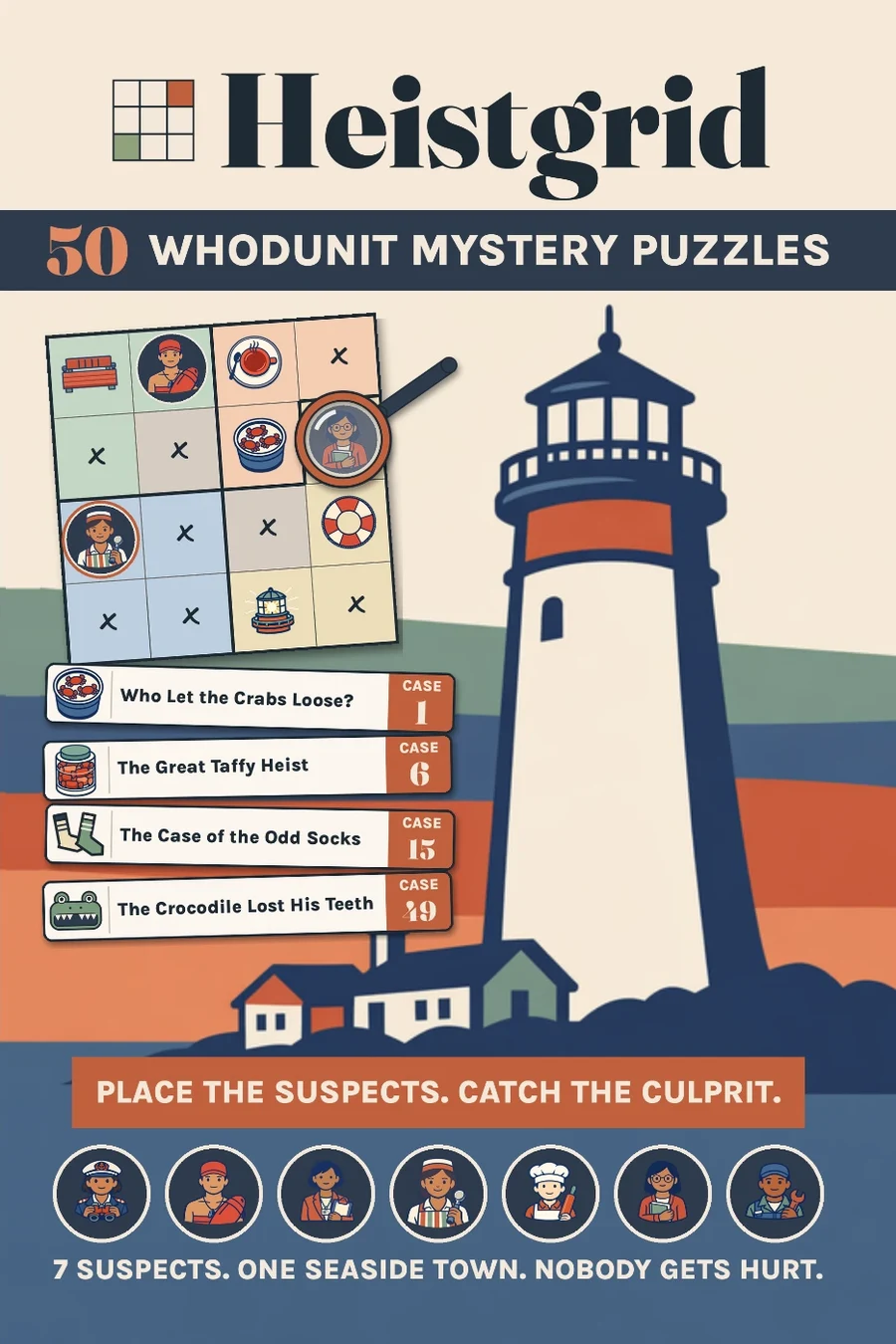
The book: 50 cases, from Junior Sleuth to Master Detective.
Buy the bookMore guides
- How to solve a logic puzzle where one witness is lying
- How hard are whodunit logic puzzles?
- Murder-mystery logic puzzles explained: Murdle, Murdoku and placement puzzles
- Cozy mystery puzzles where nobody gets hurt
- How a whodunit logic puzzle is made (and checked)
- What is the Einstein (zebra) puzzle? Logic grids vs placement puzzles
- Like sudoku? Try a whodunit puzzle