What is the Einstein (zebra) puzzle? Logic grids vs placement puzzles
Updated 10 November 2026
By the Heistgrid team, a small puzzle studio · How we check every case
The Einstein puzzle, also called the zebra puzzle, is a classic about five houses in a row, each with a different colour, owner, drink and pet, where a list of clues lets you work out who owns the fish (or, in older versions, the zebra). You solve it with a matching grid of yes/no marks, crossing out every pairing a clue rules out, while a placement puzzle like ours has you put people on a map instead.
What is the Einstein puzzle?
It's a classic logic puzzle, also known as the zebra puzzle. Picture five houses in a row. Each one is painted a different colour, and the person living there has a different nationality, a different favourite drink, a different pet and a few other things that never repeat.
Murdle is built on this kind of matching grid, with suspects, places and weapons instead of colours and pets. Murdoku and Heistgrid belong to the other family, placement puzzles, which the second half of this guide covers.
You get a list of short clues, such as who lives in the red house or which drink sits next to which pet. From those alone you work out the whole street. The final question is usually "who owns the fish?" In older versions it's "who owns the zebra?", which is where the second name comes from.
We won't print the full puzzle or its answer here. It's much more fun to find a copy and meet it fresh.
Did Einstein really write the zebra puzzle?
There's no evidence that he did. The story that Albert Einstein wrote it as a boy gets repeated a lot, but nobody has shown where it came from.
The same goes for the claim that only 2% of people can solve it. We've never seen a study behind that figure. If you're patient and keep careful notes, it's a very solvable puzzle.
How do you solve the zebra puzzle?
With a matching grid. Draw a table with people down the side and things across the top: colours, drinks, pets. Wherever a row meets a column, you'll write a yes or a no.
Every time a clue rules a pairing out, cross it out. Every time a clue confirms one, tick it, then cross out the rest of that row and column, because each thing belongs to exactly one person.
Here's a tiny made-up version. Three neighbours, Ana, Bo and Cy, each drink something different. Clue one: Bo drinks coffee. Clue two: Ana doesn't drink tea. Tick Bo and coffee and cross out the rest of that row and column. Ana can't have tea or coffee, so she has milk, and Cy is left with tea.
| Tea | Coffee | Milk | |
|---|---|---|---|
| Ana | ✗ | ✗ | ✓ |
| Bo | ✗ | ✓ | ✗ |
| Cy | ✓ | ✗ | ✗ |
The real five-house puzzle works the same way, just with many more rows and columns. The clues about position, like "next to" or "on the left of", are the ones to come back to once the grid fills in.
How are placement puzzles different from logic grids?
In a matching grid you pair things up. In a placement puzzle you put people in a place. You get a map or a board, and each suspect goes in one spot, with one person per row and one per column.
The clues are about space: who stood at the front, who was all the way left, who was next to the bookcase. Instead of reading ticks in a table, you look at the board and see where each person fits.
Our demo case works like this. Three suspects, a small library, a handful of clues. Here is the board once everyone is placed:
· front ·
 Priya
 Otto
 Mabel
The habit is the same as in the zebra puzzle: rule things out until only one choice is left. The difference is that the answer is a picture rather than a list.
Which kind of logic puzzle should I try?
If you love the five-house puzzle, you'll probably enjoy both. Matching grids reward careful bookkeeping. Placement puzzles reward seeing the board, and they tend to feel a bit more like a scene than a spreadsheet.
Our Pelican Bay cases are placement puzzles, with a whodunit at the end: once everyone is in place, one last clue points at who did it. Start with our step-by-step solving guide, read how this kind of puzzle compares in murder-mystery logic puzzles explained, or go straight to all our cases and pick one.
Try it yourself




Want 50 of these on paper?
Our book has 50 cases, from gentle to tricky, with step-by-step solutions at the back. About the book
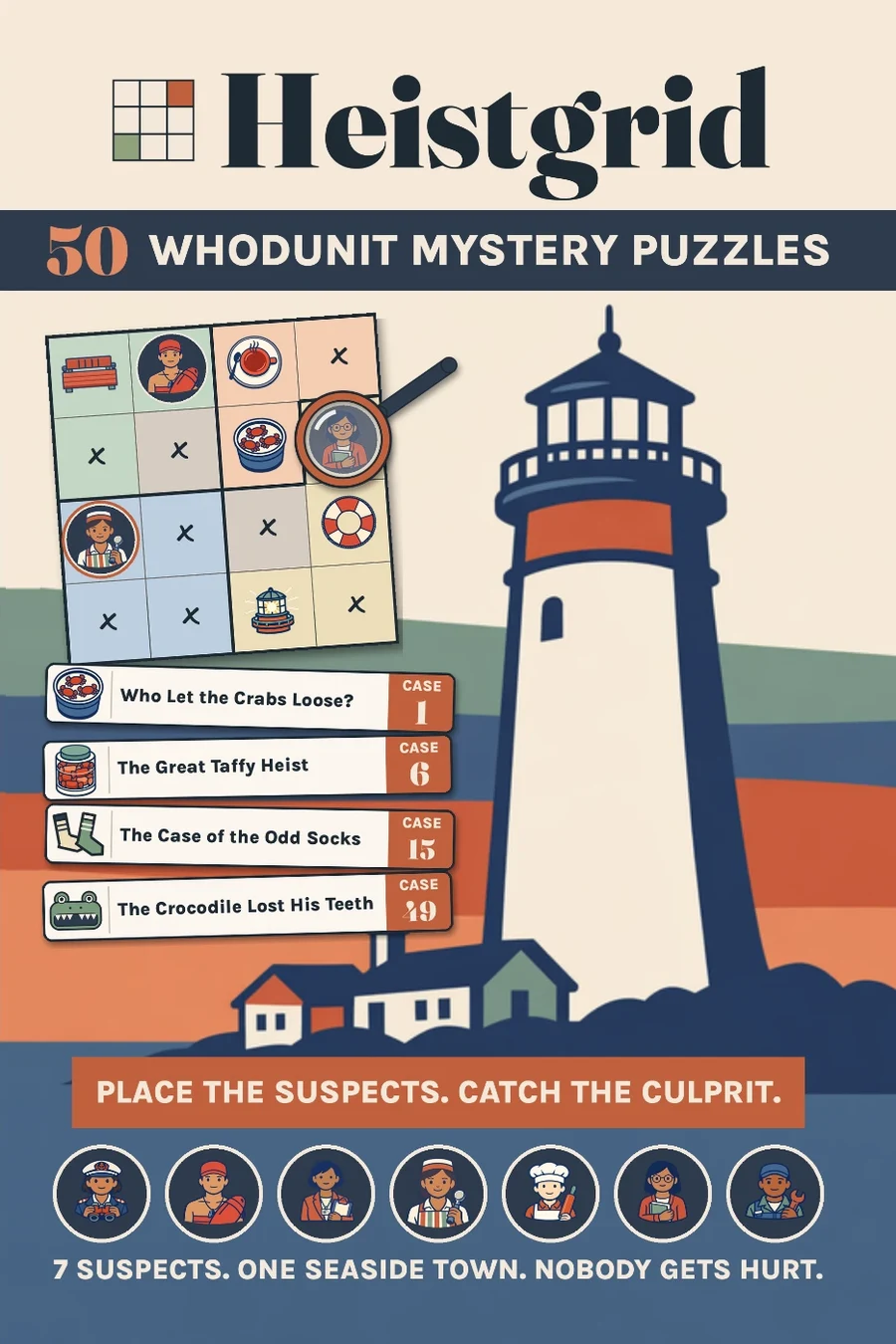
The book: 50 cases, from Junior Sleuth to Master Detective.
Buy the bookMore guides
- How to solve a whodunit logic grid puzzle, step by step
- Murder-mystery logic puzzles explained: Murdle, Murdoku and placement puzzles
- Cozy mystery puzzles where nobody gets hurt
- How a whodunit logic puzzle is made (and checked)
- Knights and knaves puzzles explained (and how liar whodunits differ)
- Like sudoku? Try a whodunit puzzle