Like sudoku? Try a whodunit puzzle
Updated 15 November 2026
By the Heistgrid team, a small puzzle studio · How we check every case
A whodunit logic puzzle runs on the same rule as sudoku — one suspect per row and one per column — only with people instead of digits, plus one final clue that names the culprit. If you like sudoku you'll pick it up as soon as you've read a clue; if you prefer KenKen's arithmetic cages or a nonogram's picture, those are different habits, and this page says which suits you.
What does a whodunit puzzle have in common with sudoku?
If you like sudoku, you already know the rule that makes a whodunit logic puzzle work: one per row and one per column. In sudoku those rows and columns hold digits. In our cases they hold people. Three suspects, three rows, three columns — each one stands in exactly one spot, so every row and every column ends up holding exactly one of them.
That is the whole mechanic. You don't count, you don't guess, and you don't need luck. A clue tells you where someone can't stand, you cross that spot off, and the board narrows the same way a sudoku narrows when a digit is ruled out. People who like the elimination part of sudoku — the quiet crossing-off — find this familiar straight away.
What's different from sudoku?
Two things. First, the board is a scene rather than a blank grid: a library, a bakery, a museum, with a shelf or a cart or a counter sitting in one spot nobody can stand on. Second, the grid itself doesn't tell you who did it. Once everyone is placed, one separate clue names the culprit — "the culprit was standing right next to the returns cart" — so the case ends with a person, not a finished grid.
For some people that is the hook: the same logic they already enjoy, pointed at a small story with an answer they can say out loud. For others it is the thing that makes it feel less like a puzzle and more like a mystery. Both are good reasons to try one.
Sudoku vs KenKen: which suits me?
KenKen keeps sudoku's one-per-row-and-column rule and adds cages: little outlined groups where the numbers inside have to reach a target using addition, subtraction, multiplication or division. If what you enjoy is pure number logic — arithmetic, targets, the click of a cage filling in — then KenKen and sudoku are closer to each other than either is to a whodunit. Our cases have no arithmetic in them at all: the constraint comes from clues written in words instead of a target number.
Sudoku vs nonogram: which suits me?
A nonogram — also called a picross or a griddler — gives you numbers along the top and the side saying how many filled spots each row and column contains, and solving it reveals a picture. The reward there is visual: you are building a shape. A whodunit puzzle asks the same kind of question about rows and columns, but the payoff is a person: who stood where, and who did it. If you like nonograms for the picture, you may simply prefer to keep doing those. If you like them for the row-and-column counting, this is that habit with suspects in it.
Do I need to be good at sudoku to try one?
No. There are no digits, no arithmetic and no clock. The one skill it asks for is reading a sentence carefully and holding it in your head — "Otto was all the way on the left", "Priya was standing to the left of Mabel". People who find sudoku fiddly often do fine here, and people who are quick at sudoku sometimes find the words slower than the numbers. Neither tells you anything about you; it is just a different material to think with.
Which case should I play first?
A Junior Sleuth case: a 3×3 board, three or four suspects, and clues that say things outright. It is about the size of an easy sudoku and it fits in one sitting. The free cases play in your browser, so you can find out whether the story part lands for you before you commit to anything.
If you would like the method spelled out first, our guide to solving logic grid puzzles walks through a whole case one clue at a time, and our page on murder-mystery logic puzzles covers where these come from and how they differ from the matching grids in Murdle.
Try it yourself




Want 50 of these on paper?
Our book has 50 cases, from gentle to tricky, with step-by-step solutions at the back. About the book
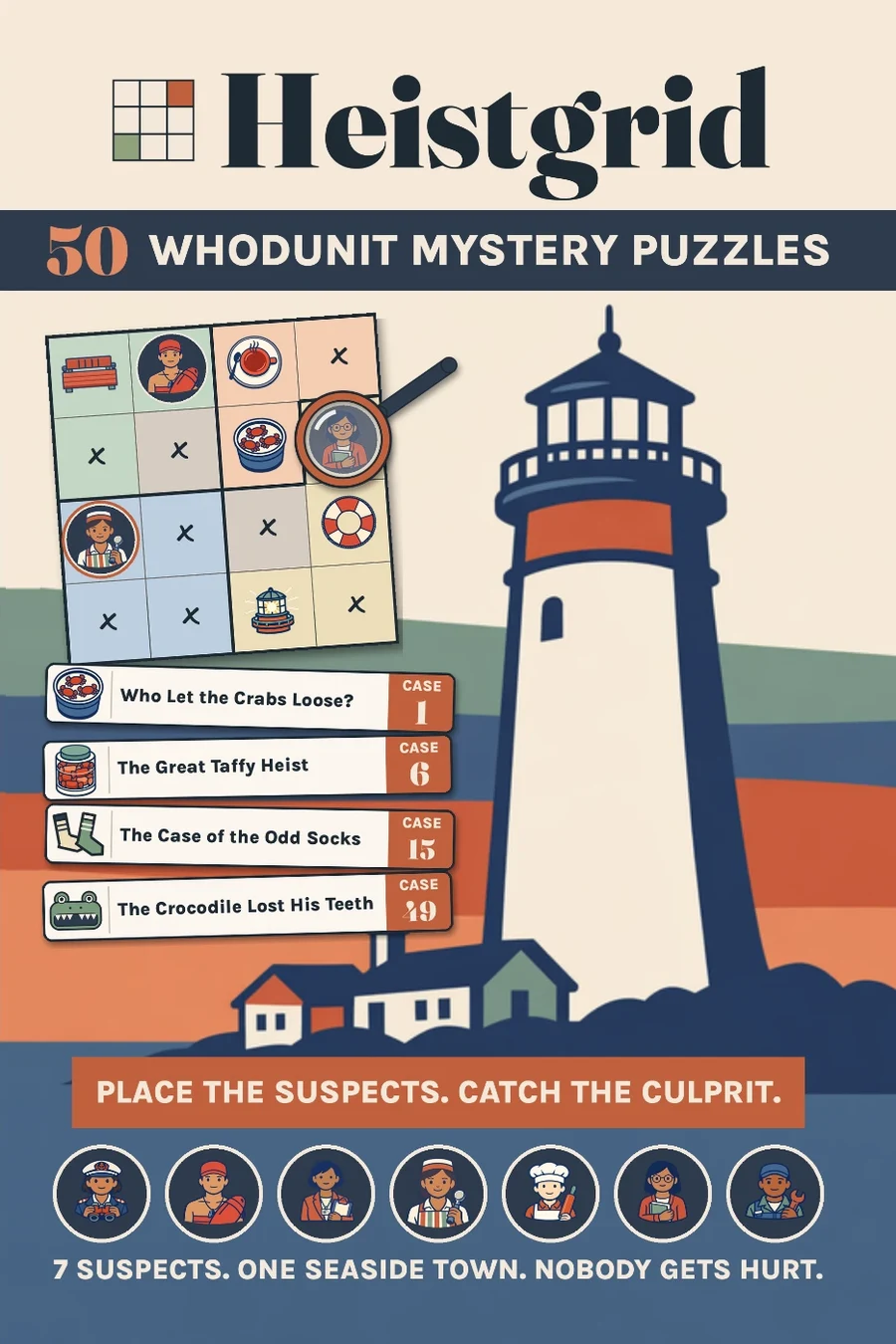
The book: 50 cases, from Junior Sleuth to Master Detective.
Buy the bookMore guides
- How to solve a whodunit logic grid puzzle, step by step
- Murder-mystery logic puzzles explained: Murdle, Murdoku and placement puzzles
- Cozy mystery puzzles where nobody gets hurt
- How a whodunit logic puzzle is made (and checked)
- Knights and knaves puzzles explained (and how liar whodunits differ)
- What is the Einstein (zebra) puzzle? Logic grids vs placement puzzles