How a whodunit logic puzzle is made (and checked)
Updated 5 November 2026
By the Heistgrid team, a small puzzle studio · How we check every case
A whodunit logic puzzle is made by drafting a scene, a set of suspects and a page of clues, then running it through a computer solver that tries every placement until the case has exactly one solution and exactly one culprit. That check is the reason these puzzles are fair: the answer never depends on a guess or on something the clues didn't tell you.
Where does a whodunit puzzle start?
Usually with a place: somewhere a handful of people would have a reason to be at the same time, and a few rooms to stand in. Then we pick the suspects who belong there and write the clues — who stood beside whom, who was alone, who wasn't in the room at all.
Heistgrid cases are in the Murdoku family: suspects placed on a scene, one per row and column. The check described here is what separates a puzzle that is fair from one that only looks like it.
At that point a case is only a sketch. Most of the work happens afterwards, and most of it is checking.
How do you know a puzzle has exactly one answer?
We run it through a solver. A computer tries every possible way to place the suspects on the grid and counts the arrangements that fit all the clues. Exactly one may fit. Two, or none, and the case goes back to the drawing board.
The solver checks the culprit too: the clues have to point at exactly one person. A case where two people could have done it isn't a puzzle, it's a coin flip.
Why does every clue matter?
Once a case has one answer, we try to take it apart. Clues come out one at a time and the solver runs again. If the case can still be solved without a clue, that clue goes.
Made-up example: a case says Ada stood in the boathouse, Ben wasn't in the kitchen, and Cleo was beside Ada. If removing the clue about Ben leaves the case solvable, Ben's clue was decoration, so it comes out. What's left is everything you need and nothing you don't.
Why can't you guess the culprit early?
The last clue — the one that names the culprit — points at an object: a chair, a crate, a window. That object never appears in any of the other clues, so nothing tells you who did it before you've placed everyone else.
It's a small rule and it protects the shape of the case. You solve the board first, and the answer arrives at the end rather than in the second sentence.
How do you check a puzzle where someone lies?
In the cases with a lying witness, the solver runs the check once per witness: each person is treated as the liar in turn, and the other statements are solved as true. Exactly one of those choices may give a complete answer. If two of them do, the case is ambiguous and we rewrite it.
Does a computer decide whether a puzzle is good?
No. A solver can tell us a case is fair; it can't tell us it's fun. So people play the cases on paper and online, and we watch where they stall, where they give up, and where they finish smiling.
That's how the order gets set too. We think we know which case is harder, then the players tell us, and the cases get rearranged by how hard they really turn out to be.
What happens if I find a mistake?
Tell us. We run the case through the solver again, and if it's genuinely wrong we fix it in the next printing. A reported mistake is the most useful thing a player can send us.
So are these puzzles fair?
That's the question behind all of this, and the honest answer is yes — by construction. Every case has one solution and one culprit, no clue you don't need, and no answer that depends on guessing what we were thinking. If you're stuck, the answer is somewhere in the clues.
The short version of all this lives on the how-we-make-puzzles page, with a way to get in touch. If you'd rather try the checking yourself, pick a case from the case list and see whether you can break it.
Try it yourself





Want 50 of these on paper?
Our book has 50 cases, from gentle to tricky, with step-by-step solutions at the back. About the book
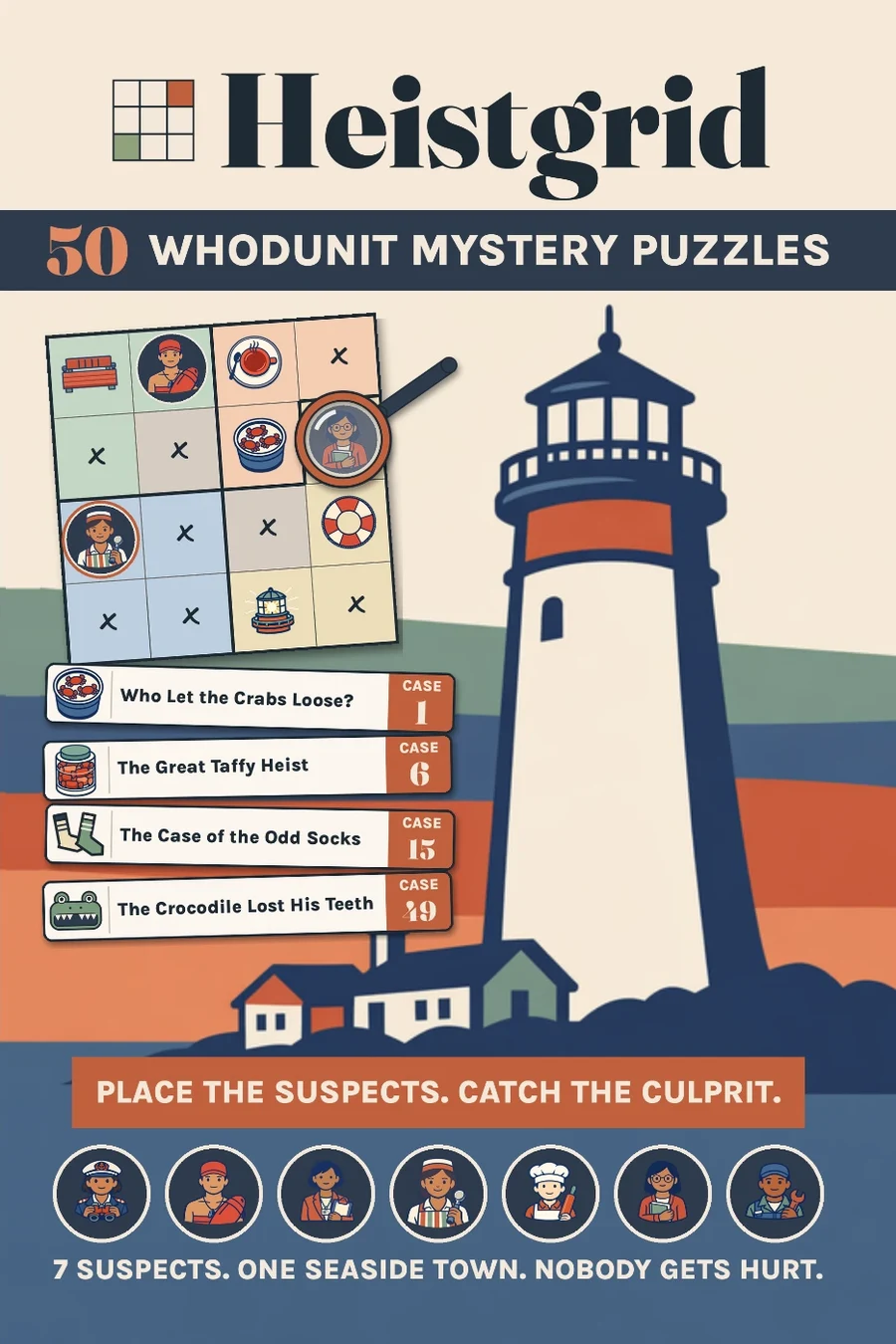
The book: 50 cases, from Junior Sleuth to Master Detective.
Buy the bookMore guides
- How to solve a whodunit logic grid puzzle, step by step
- How to solve a logic puzzle where one witness is lying
- Murder-mystery logic puzzles explained: Murdle, Murdoku and placement puzzles
- Cozy mystery puzzles where nobody gets hurt
- Knights and knaves puzzles explained (and how liar whodunits differ)
- What is the Einstein (zebra) puzzle? Logic grids vs placement puzzles
- Like sudoku? Try a whodunit puzzle