Cozy mystery puzzles where nobody gets hurt
Updated 31 October 2026
By the Heistgrid team, a small puzzle studio · How we check every case
A cozy mystery puzzle is a whodunit with no violence: the crime is a missing pie or a swapped sign, and the fun is proving from the clues exactly who did it. Our Pelican Bay cases are made for adults and gentle enough to solve with the whole family — nobody ever gets hurt.
What is a cozy mystery puzzle?
It's a whodunit with the sharp edges taken off. There's still a crime, a handful of suspects, a trail of clues and one culprit to catch — but nobody gets hurt, and nobody is ever in danger. In our cases the "crime" is something like a missing pie or a swapped sign, and your job is to prove, from the clues, exactly who did it.
Murdle and Murdoku, the best-known murder-mystery puzzle series, are built around murder cases. If you like that style of puzzle but prefer a gentler story, this is the cozy version of it. Murdle, Murdoku and placement puzzles explained shows how they differ.
That puts cozy mystery puzzles in the same family as the classic logic grid: small cast, tight rules, one answer. If you've ever enjoyed working out whodunit from a page of clues, this is that feeling with a board in front of you.
It's also a different read from most crime fiction. A detective novel usually spends its first chapters on the harm, and the puzzle arrives later. A cozy puzzle starts at the puzzle. The story is there to give the clues a home: this suspect has a reason to be by the pie rack, that one wouldn't dare walk past the harbourmaster. You solve a scene, not a tragedy.
And unlike a crossword or a sudoku, you get a story to hang it on. The grid is a place — a pier, a bakery, a museum hall — and the names on it belong to people you'll meet again in the next case. That's what makes the answer feel earned rather than merely correct.
Can a puzzle be a real whodunit if nobody gets hurt?
Yes, and it's worth asking why. What makes a whodunit satisfying isn't the crime itself — it's everything around it. A cast of suspects who each had a chance. Clues that pin people down. Alibis that almost hold. A moment at the end where everything clicks and you can point at one person and say: it was you, and here's the proof.
None of that needs a body. In a Pelican Bay case you get the same suspects, the same alibis and the same catch-the-culprit finish, only the stakes are who took the pie off the rack or who turned the sign around. The satisfaction comes from the deduction, and the deduction is every bit as real.
We'd go further: gentle stakes free you up. You can think about the puzzle instead of the victim, and there's no grim twist waiting at the end. When you're done, the town is exactly as you found it — minus one pie, and minus one secret.
How does a Heistgrid case work?
Two steps, in this order:
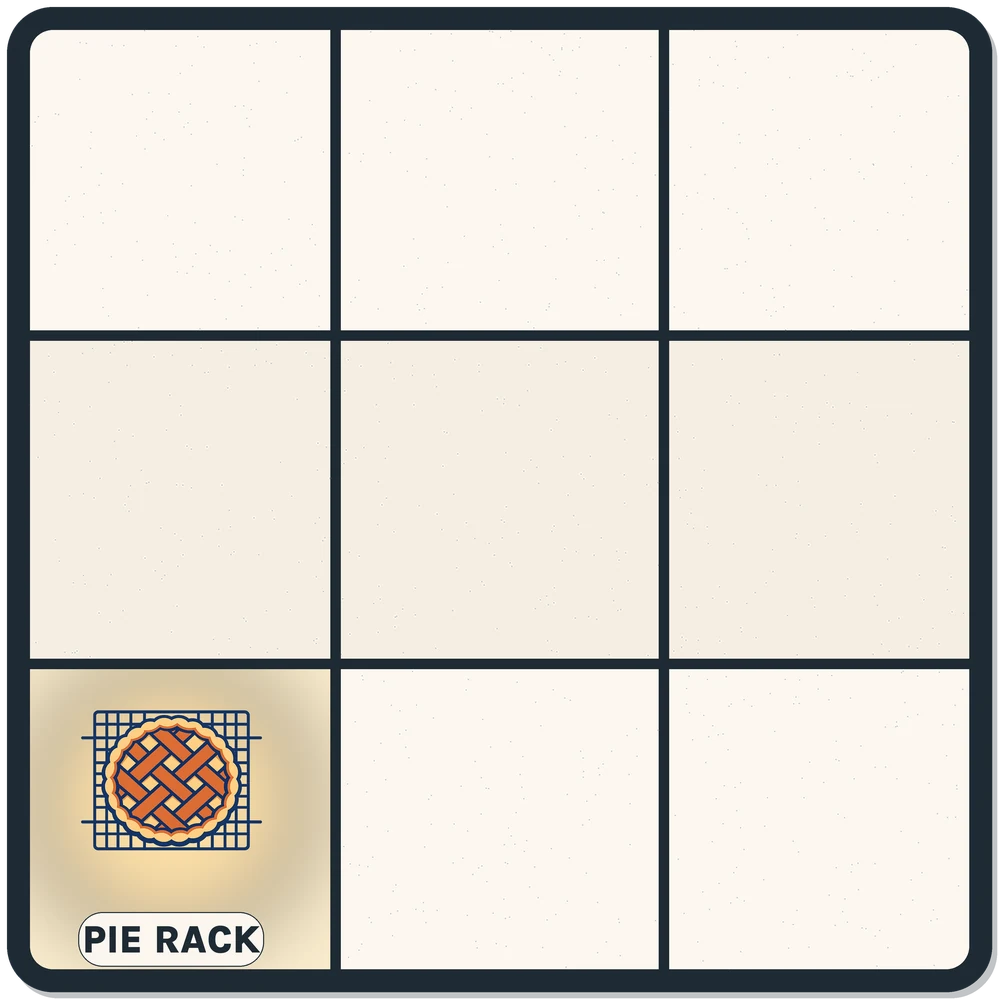
- Place every suspect. The scene is a small grid, and no two suspects can share a row or column. The clues tell you who stood where — who was at the front, who was next to the counter, who had to be in a corner. Each suspect you place knocks the remaining squares out for everyone else, so the board tightens as you go.
- Read the final clue. One last clue names the culprit once the board is full. It might be about position, or about who could reach what. When your placement is right, exactly one person fits it. If two people fit, the board isn't right yet — that's the built-in error checker.
Grey squares hold objects, so nobody can stand there. That's the whole rulebook. If you'd like the rules with pictures, our step-by-step guide walks through a full case.
On paper, small pencil marks in the corners of a square help: jot the two or three people who could still stand there, and rub them out as rows and columns fill up. In the browser version you can tap the same marks onto a cell.
Do I need to be good at logic puzzles already?
No. The smallest cases need no technique at all — just patience and a pencil. A clue says the postwoman stood at the front; there's one front square; you write her in. Everything after that follows from rows and columns filling up.
What the puzzles ask of you is care, not cleverness. Read each clue twice, prefer the clue that pins someone to an exact spot, and don't guess — if a choice feels like a coin flip, there's another clue that decides it for you. Our guides collect the habits worth learning, one idea at a time.
If you can fill in a crossword clue or keep score in a card game, you have every skill this needs. The rest — knowing which clue to trust first, spotting when a row is already spoken for — is exactly what the guides and the easy cases teach.
Are these puzzles suitable for the whole family?
They're written for adults, and they're gentle enough to solve together. One person reads the clues aloud and everyone argues about who stood where. That argument is the point.
Nothing in the story is scarier than a pilfered tart. The suspects bicker a little and everybody's fine in the end. If a younger solver joins in, give them the job of checking that no two suspects share a row — it's a real contribution and it keeps the board honest.
A tip from our own testing: start a case fresh rather than halfway. A clean board and a slow first clue is how the youngest solvers get their first full win. And let them read the final clue aloud when the board is done — catching the culprit is the best part, and it should belong to whoever did the last piece of work.
The cases work on a screen and on paper, and they were designed for a pencil first. If you'd rather keep phones out of family time, print-style solving on paper gives you the same puzzle with the table in the middle of it.
What actually happens in these cases?
Petty theft and small mischief, mostly. A pie goes missing from a rack. A sign gets turned around overnight. Bait buckets, date stamps, pond pebbles. The town of Pelican Bay takes its small crimes seriously, and so do the suspects.
Here's the shape of a made-up case, so you know what to expect. The bakery's window sign has been swapped, and three people were nearby: a fishmonger, a postwoman and a retired lifeguard. Clue one puts the postwoman at the front of the shop. Clue two says the fishmonger stood left of somebody. By the time the board is full, the final clue — the culprit stood directly beside the sign — fits exactly one of them. No shouting, no handcuffs. Just a quiet "ah, it was you", and on to the next case.
The fun is in the cast as much as the logic. A lifeguard who is firmly off duty. An ice-cream vendor who saw everything and tells you about it in three separate statements. A baker whose alibi is, of course, that the bread needed him. They recur from case to case, so a family starts taking sides.
Where should a family start?
Start with a Junior Sleuth case. Those are the smallest boards — three suspects on a 3×3 grid — with direct clues that pin people to edges and corners. They're short enough for a first-timer to finish in one sitting, and finishing is what hooks people.
From there the cases grow: bigger boards, objects that block squares, and eventually witnesses where one of them is lying. But the gentle start matters. A cozy mystery should feel like a warm evening with a pencil, not a test.
The case below this guide is one of those gentle ones. The book version has fifty of them, from that size up, with step-by-step solutions at the back.
Try it yourself




Want 50 of these on paper?
Our book has 50 cases, from gentle to tricky, with step-by-step solutions at the back. About the book
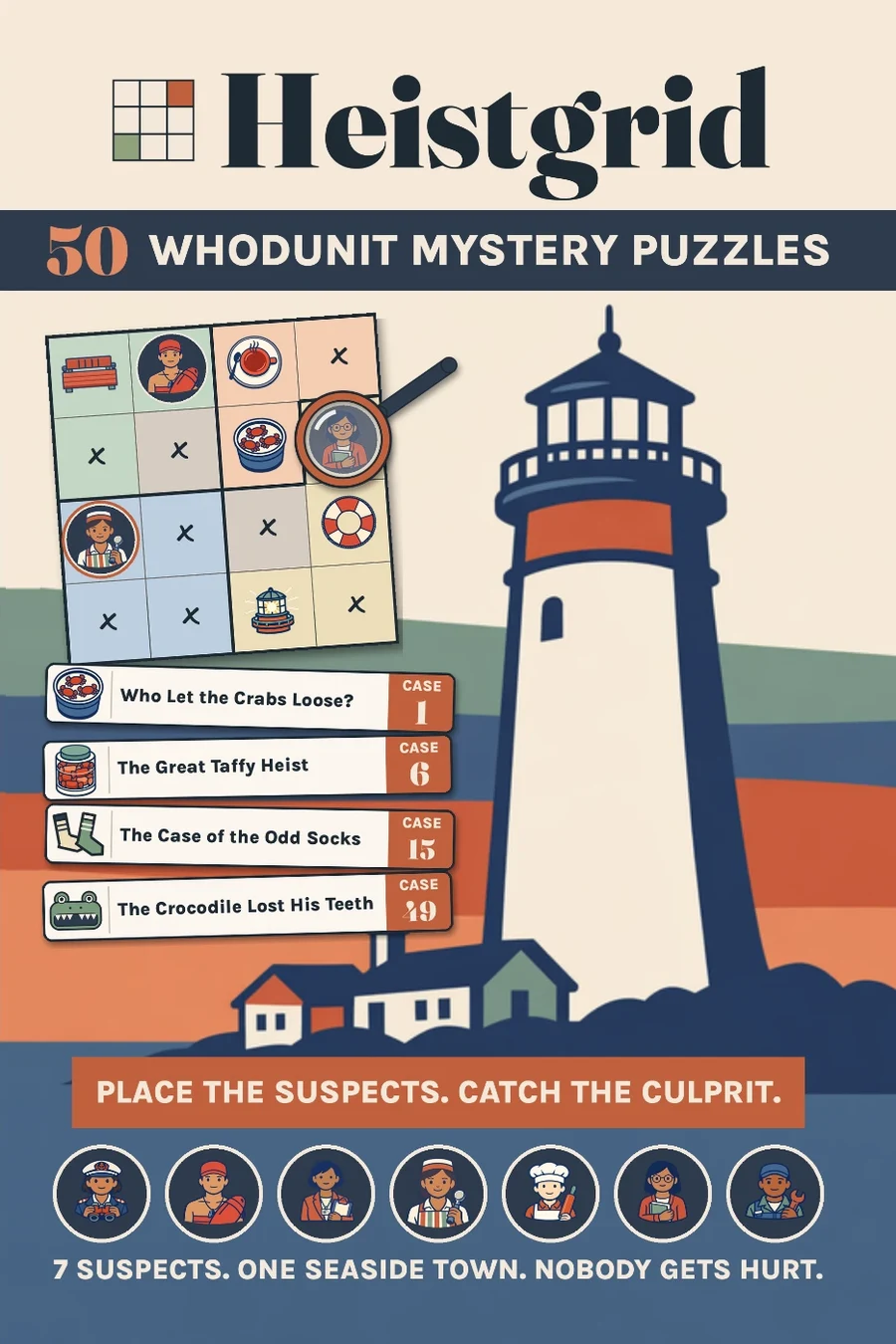
The book: 50 cases, from Junior Sleuth to Master Detective.
Buy the bookMore guides
- How to solve a whodunit logic grid puzzle, step by step
- Murder-mystery logic puzzles explained: Murdle, Murdoku and placement puzzles
- How a whodunit logic puzzle is made (and checked)
- Knights and knaves puzzles explained (and how liar whodunits differ)
- What is the Einstein (zebra) puzzle? Logic grids vs placement puzzles
- Like sudoku? Try a whodunit puzzle