A whodunit puzzle for two: solving together
Updated 12 November 2026
By the Heistgrid team, a small puzzle studio · How we check every case
A good mystery game for couples is a whodunit you solve at one board: one of you reads the clues out loud while the other places the suspects, and you swap jobs each case. It's a murder mystery game for two people rather than a party game — a quiet evening, one board, and a culprit you have to agree on.
Is there a good mystery game for couples?
Yes — the kind where two people sit side by side at one board with one page of clues. A whodunit puzzle for two works because the jobs divide themselves: one of you reads, the other places, and both of you have to agree on the culprit in the end. Nothing here needs a host, a script or a fourth person. It's a quiet evening for two, not a party game.
The shape of the evening is simple. A small scene drawn as a grid, a handful of suspects, a page of clues, and one answer you prove together. One of you will be right about something the other missed, and that's the whole point.
How do two people solve a whodunit together?
Split the jobs, then swap them every case. One of you reads the clues out loud, slowly, and keeps the page. The other places the suspects on the board and says what they're doing as they do it: "Otto goes here, because the clue says he was all the way on the left." Next case, you trade.
Reading is the harder job than it looks — you have to hold back and let the other person think. Placing is the noisier one, because every clue turns into a small decision about where someone stands. Swapping each case stops one of you becoming the reader for the whole evening and the other becoming furniture.
How do pencil marks help two people talk?
Solving alone, a pencil mark is a note to yourself. With two people it becomes a sentence: "could Otto be here?" You put a small mark in every spot a suspect is still allowed to stand, and the argument is about marks instead of hunches. "I think he can't be there" is easy to answer with a clue; "I don't like that spot" isn't.
· front ·
Marks also break the standoff where neither of you wants to place anyone for real. A mark isn't a commitment — it's a maybe, and it comes off the moment a clue rules it out. If you want the habit explained properly, our guide to pencil marks covers it end to end.
What do we do when we disagree?
Have one rule ready, and make it boring: go back to the clue and read it again, word for word, out loud. Most disagreements aren't about logic at all — one of you quietly added something the clue didn't say, like hearing "next to the cart" as "in front of the cart". Reading the words again usually settles it in seconds.
The other half of the rule is knowing there is something to settle on. Every case we publish is checked to have exactly one solution and exactly one culprit, so a disagreement is never a matter of taste. One of you is right, and the clue says which.
Is this a party game?
No. It's a quiet evening for two. A board this small doesn't carry a room full of people, and it doesn't need to. Two cups of something, one lamp, one board and a page of clues is the whole setup — the kind of thing you do on a Tuesday rather than at a birthday.
If you do want more people at the table, the same job-split stretches: one adult reads the clues out loud and everyone else places. Our family game night guide explains how that works with children and teens in the room.
Which case should we play first?
Start with a Junior Sleuth case: a 3×3 board, three or four suspects, and clues that say things outright — "at the front", "all the way on the left", "in the middle row". Both of you can follow it without anyone having to explain the rules twice.
Read every clue once before placing anyone, then let "one per row and column" do the rest. If you'd like the method spelled out first, our guide to solving logic grid puzzles walks through a whole case one clue at a time.
Try it yourself





Want 50 of these on paper?
Our book has 50 cases, from gentle to tricky, with step-by-step solutions at the back. About the book
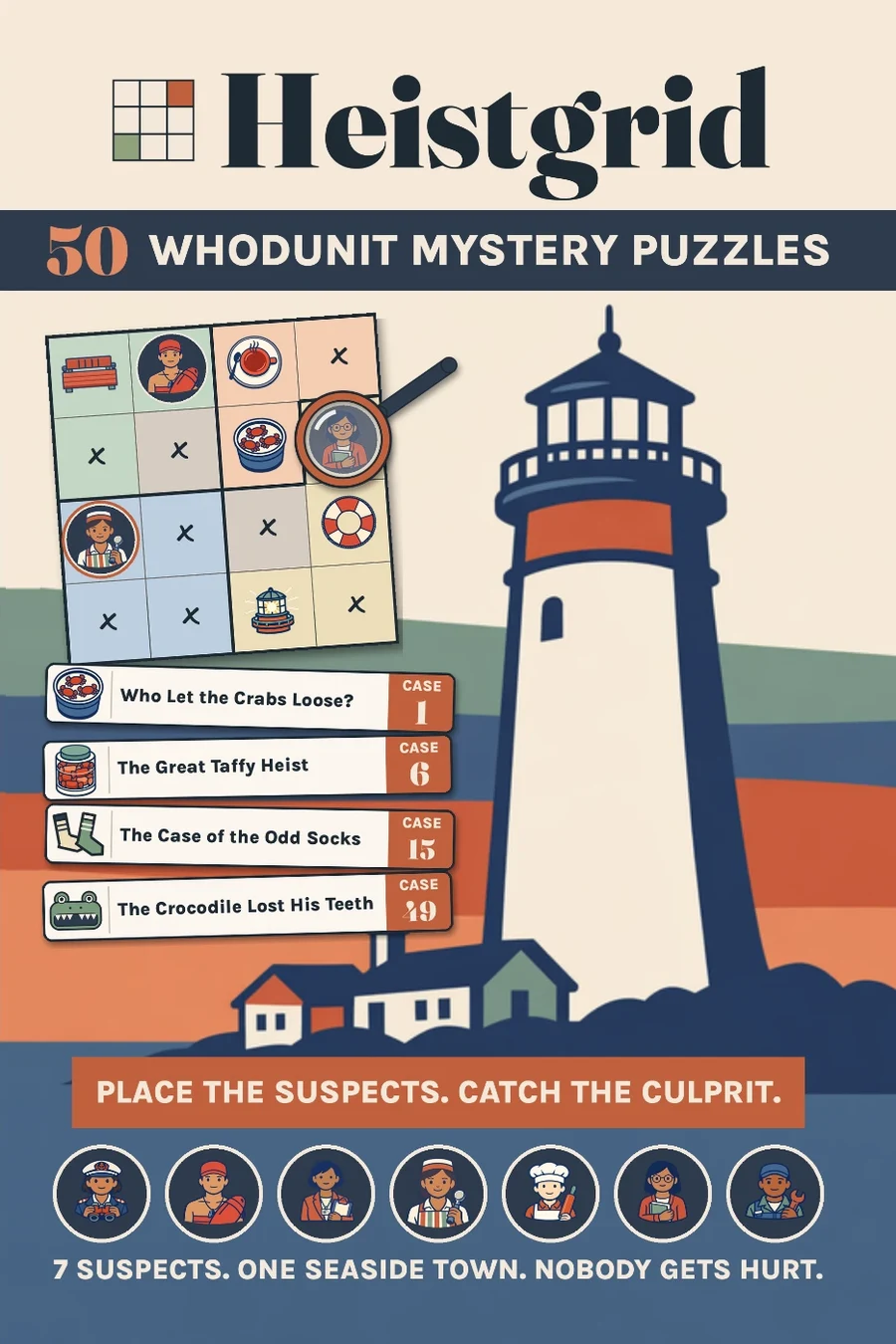
The book: 50 cases, from Junior Sleuth to Master Detective.
Buy the book