Pencil marks: the trick that makes hard logic puzzles easy
Updated 3 November 2026
By the Heistgrid team, a small puzzle studio · How we check every case
Deductive reasoning in a logic puzzle means writing down every square a suspect could still stand in, then crossing those squares off one by one until only one possibility survives. Those notes are called pencil marks or candidates, and they turn a hard board into a series of small, obvious steps.
What is a pencil mark in a logic puzzle?
A pencil mark — usually called a candidate — is a note about where a suspect could still stand. It isn't a guess about who did it. It says only this: on the evidence so far, this person is allowed to be in this square.
The same habit works for any placement whodunit, Murdoku-style books included: if you can note candidates in a sudoku, you can do it here, with suspects instead of digits.
The value is in the rubbing out. Every clue you read, and every suspect you place for real, makes some of those notes wrong. Cross them off one at a time, and what survives isn't a hunch — it's the only thing left.
How do I take pencil marks on paper?
A small initial in the corner of a square. Give each person their own corner, so four initials can share a square without turning into mush. Write light, keep a soft eraser nearby, and rub a letter out the moment a row, a column or a clue rules it out.
Solvers who skip the marks try to hold the whole board in their head — and usually lose it around the seventh clue. The marks are the same information, written down where you can't drop it.
How do pencil marks work in a Heistgrid case?
In our app you don't need the eraser. Select a suspect, then tap a small corner box in an empty square to drop their mark there; one square can hold up to four. Place someone for real and their other marks clear themselves across the whole board, so the bookkeeping happens on its own and your attention stays on the clues.
What is the "only one place left" pattern?
Here's the demo board from our how-to-play page: a 3×3 library, three people, and a returns cart sitting in a grey square that nobody can stand on.
· front ·
· front ·
· front ·
 Priya
 Otto
 Mabel
The first clue says Priya was at the front, so she gets a mark in all three front squares — the clue narrows her, it doesn't place her. The second says Otto was all the way on the left, so the front-left square is his and Priya's mark there comes off.
Then the third clue: Priya stood to the left of Mabel. That rules the right column out for her, and she's down to a single marked square. A suspect with exactly one mark left isn't a possibility any more — it's a placement. Put her there, and the same thing happens to everyone else who was sharing her rows and columns.
What is the "only one person left" pattern?
Flip the same marks around and ask about a square instead of a person: who is still allowed to stand here? Made-up example: the middle square can't take Ada, because her row already holds someone, and it can't take Ben, because his column already does. That leaves Cleo — not because a clue named her, but because nobody else fits.
Both patterns come from one set of marks. The first reads down a name, the second reads down a square. Most solvers who feel stuck are only reading names, and the square-level answer was sitting under their pencil the whole time.
Should I mark every empty square?
No — mark where a clue points, not everywhere. Blanket-marking every empty square gives you a board full of initials and no information, and you'll spend the next ten minutes reading letters instead of thinking. If a square has four names in it, you haven't learned anything about it yet; go read a different clue and come back.
Start with the clues that pin someone to a range — a row, a column, a room — and keep the marks few enough that you can count them at a glance.
What should I play next?
Pencil marks are the whole trick behind the harder cases, so it's worth practising them on a board you can finish in one sitting. The rules for reading a board are on the how-to-play page, and the ranks are listed together on the case page. If you like the idea of a witness who isn't telling the truth, our liar-puzzle guide walks through that one too.
Try it yourself


Want 50 of these on paper?
Our book has 50 cases, from gentle to tricky, with step-by-step solutions at the back. About the book
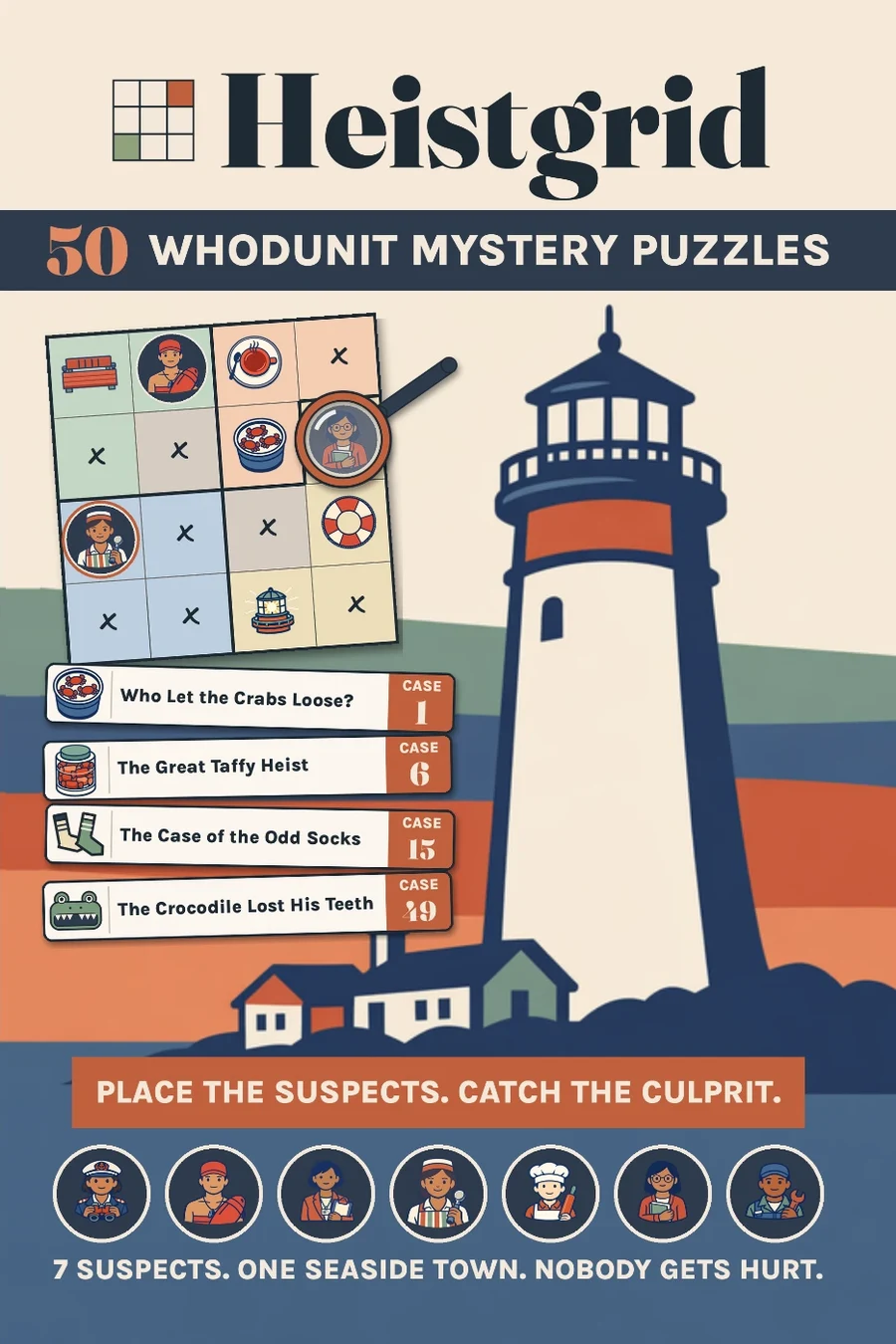
The book: 50 cases, from Junior Sleuth to Master Detective.
Buy the book