Gift ideas for puzzle lovers who like a mystery (Murdle, Murdoku and more)
Updated 3 November 2026
By the Heistgrid team, a small puzzle studio · How we check every case
The best gifts for puzzle lovers come in five types: logic-grid puzzle books like Murdle, placement-style whodunit puzzles like Murdoku and Heistgrid, mystery jigsaw puzzles, cozy mystery novels, and a good pencil-and-eraser set for solving on paper. Pick by how they like to solve — alone with a pencil, or around a table with other people.
What makes a good gift for a puzzle lover?
Match the gift to how they already spend an evening. Some people solve alone with a pencil and a cup of tea; others want a table of people arguing about who did it. This list is by type rather than by brand — nothing here is sponsored, and there are no affiliate links.
Three things are worth checking on any of them. The rules should be clear enough to read in a minute. There should be a gentle start, so the first puzzle is winnable. And the answers should be at the back, showing the reasoning and not just the finished grid — a solver who gets stuck with no way out stops solving.
What is a logic-grid puzzle book?
The classic form. You get a table of names, places and things, a page of clues, and you cross off combinations until exactly one answer survives. It's quiet, solitary work, and it suits the person who likes a puzzle to themselves with a pen in hand. Murdle, the puzzle books by G. T. Karber, is the best-known mystery take on it: you match who, where and with what until the culprit is the only one left.
What to look for: rules stated in one short paragraph, an opening section that's genuinely easy, and solutions that walk through the steps. A grid book that starts hard is the one most often left half-done on a shelf.
What is a placement-style whodunit puzzle book?
A newer kind, and the one we make. Murdoku, created by Manuel Garand, is the name most people know it by. Instead of a table you get a picture of a scene drawn as a small grid, and you place the suspects on it from the clues — nobody in the same row or column, grey squares taken by objects. Once the board is full, one final clue tells you who did it.
It suits people who want a story with their logic and would rather put people in a room than tick boxes in a table. Look for the same cast coming back from case to case, a ladder of difficulty so the first ones are kind, and worked solutions at the back.
Ours is Heistgrid: Whodunit Logic Puzzles: fifty cases set in a seaside town, where the worst crime is a missing pie and nobody ever gets hurt. It's a paperback, and the book page links to where to get it.
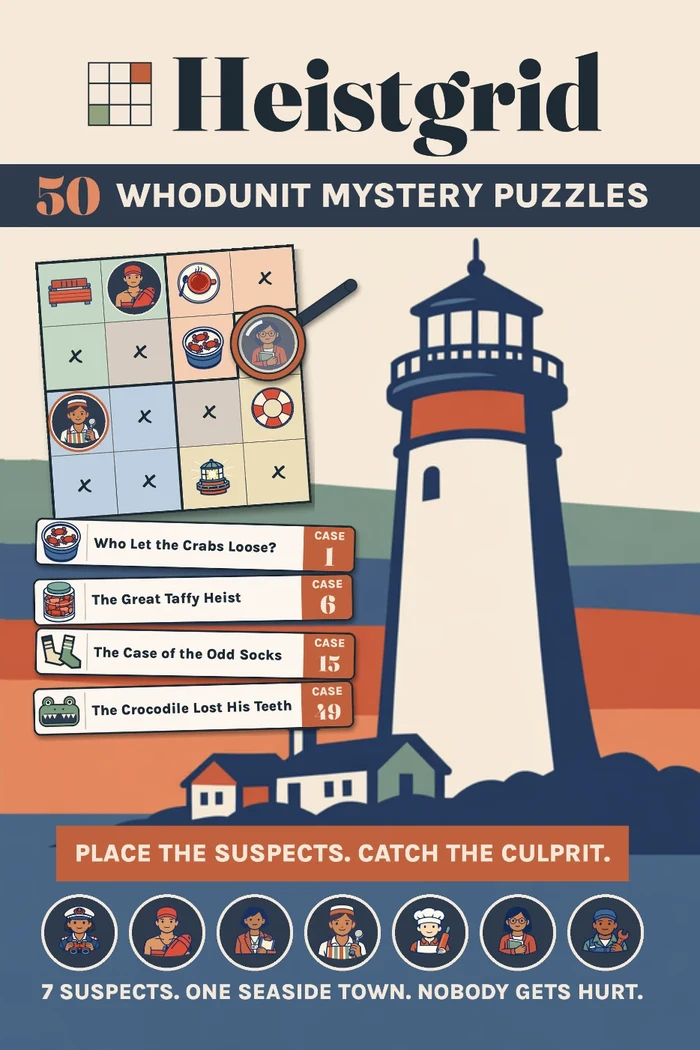
Heistgrid isn't affiliated with Murdle or Murdoku; we name them because they're the books and puzzles people look for in this corner of the shelf.
Are mystery jigsaw puzzles a good gift?
For a household, yes. A jigsaw with a story to it — a harbour scene, a crowded station, a museum hall — gives a group something to do together, and a hidden-detail version adds the whodunit layer on top.
What to look for: a picture you'd actually want to look at, a piece count the group will finish rather than abandon, and a print with enough variety that the sky isn't forty identical grey pieces.
Should I get a cozy mystery novel instead?
For someone who reads on a commute, a cozy mystery is a lovely gift: a crime, a cast of suspects, an amateur sleuth, and harm kept off the page. The pleasure is a fair puzzle you follow rather than solve yourself.
What to look for: a series with a sleuth you'd happily spend ten books with, and clues the reader could genuinely use. One honest caveat — a novel isn't a puzzle you work with a pencil. If they want to do the thinking themselves, get a puzzle book instead.
What else does someone who solves on paper need?
A good pencil and a soft eraser. It sounds like a small thing until you've spent an afternoon with a pencil that smudges and an eraser that drags marks across the grid.
What to look for: a pencil that writes dark but doesn't smear under your palm, an eraser that lifts cleanly instead of rubbing the mark in, and something firm to solve on. It's a modest gift, and it's the one a solver reaches for every time.
What are good Christmas gifts and stocking stuffers for puzzle lovers?
A stocking wants something small that still gets used. A slim logic-puzzle book fits the bill: one puzzle a day for the season, with the answers at the back for the one that defeats them. A pocket puzzle pad does the same job in a smaller package — a block of short cases for a bag, a waiting room or a train seat, and the kind of thing that gets finished rather than admired.
A good pencil-and-eraser set is the classic stocking filler for someone who solves on paper, and rarely something they buy themselves: a pencil that writes dark without smearing under your palm, and an eraser that lifts a mark instead of dragging it across the grid.
A little bigger, a mystery jigsaw keeps a table busy through the holidays, and a cozy mystery novel is a gift for the reading chair in between.
Then there's the gift that isn't an object: an evening of solving together. Pick a case, put a laptop on the kitchen table, and make someone else the head detective for the night. If you'd rather wrap something, our paperback is on the book page.
How do I choose between them?
Quiet and solitary, with a pen: a logic-grid book such as Murdle. Story and logic together: a placement whodunit such as Murdoku or Heistgrid. A table of people and an afternoon: a jigsaw. A commute and a reading chair: a cozy novel. Any of the above: the pencil set.
And if you'd like to see whether the puzzle-clicks feeling lands before you buy anything, our free cases cost nothing to try — a pencil, a browser, and one small seaside crime to sort out.
Try it yourself




Want 50 of these on paper?
Our book has 50 cases, from gentle to tricky, with step-by-step solutions at the back. About the book
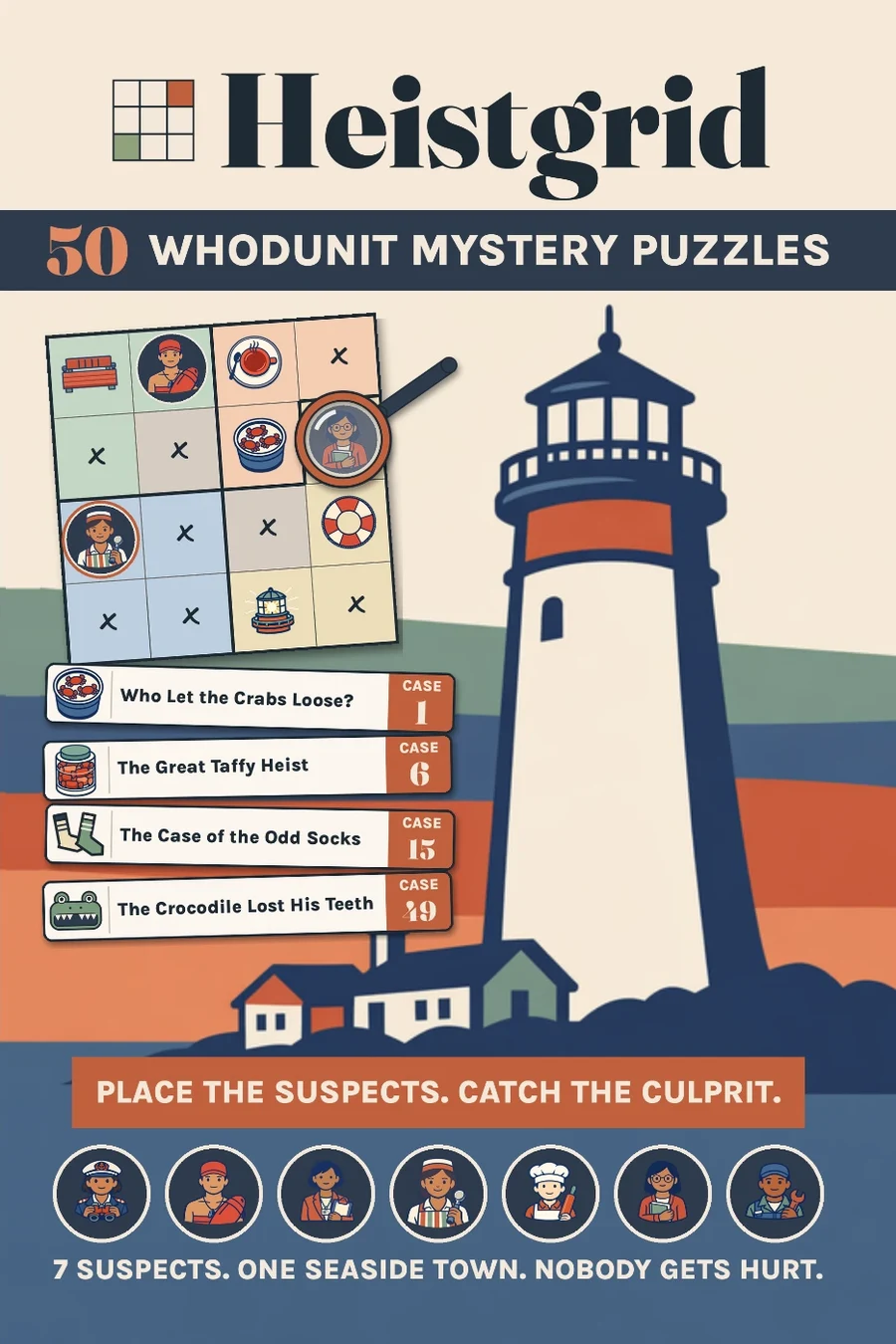
The book: 50 cases, from Junior Sleuth to Master Detective.
Buy the book