Screen-free puzzles for adults: why paper still wins
Updated 4 November 2026
By the Heistgrid team, a small puzzle studio · How we check every case
Screen-free activities for adults hold up best when they have a clear beginning and end, something for your hands, and no notifications — a quiet hour with a puzzle is the simplest version of that. A pencil-and-paper mystery puzzle is the quietest of them all: a scene drawn as a small grid, a page of clues, and a culprit you prove from them.
What are good screen-free activities for adults?
The ones that work have three things in common: a clear beginning and end, something for your hands, and no screen pulling at the edge of the table. Board games and cards cover the social end of that list. For an evening on your own, the quiet end is better — a book, a jigsaw, or a puzzle with a pencil.
Paper mystery puzzles like Murdle, Murdoku and our own Heistgrid are a good fit for this: a self-contained case, a pencil, and an answer you reach yourself.
A logic puzzle fits the quiet end exactly. One case is a quiet hour: a board, a page of clues, and a culprit to name at the end. Nothing pings, nothing refreshes, and the case doesn't mind how long you take.
What is a pencil-and-paper mystery puzzle?
It's a whodunit you solve with a pencil instead of reading. The scene is drawn as a small grid — a shop floor, a hall, a yard — and the clues tell you where each suspect stood. One suspect per row and per column, grey squares taken by objects, and one final clue that names the culprit once the board is full.
You can do the whole thing on paper: draw the grid, write names in the squares, rub out the ones the clues rule out. That is the format our cases come in, and it's the one we designed the puzzles for.
Why does paper suit deduction better than a screen?
Deduction is mostly elimination, and paper is good at elimination. A mark in the corner of a square is a thought you can see; a square rubbed out is a thought you've finished with. Both stay put while you look at the rest of the board, and a soft eraser makes a wrong turn cheap.
The other thing paper gives you is the whole grid at once. No scrolling, no zooming, no panel sitting over the column you're thinking about — the board and the clues fit in one look, and that's usually where the "only one square left" moments happen.
How do I set up a screen-free puzzle evening?
A table and a lamp. One case each, or one case shared with someone reading the clues out loud. A pencil that writes dark and an eraser that lifts cleanly. Something firm underneath. A mug. The phone in another room — that's the whole setup.
Give yourself an hour and don't rush the first one. If you're solving with someone, decide who holds the board for the night; two people writing on one grid is how friendships get tested.
Do I need to buy something to play on paper?
No. The free cases on this site are a sample — seven of them — and you can copy a board onto paper and solve it there if you'd rather keep the pencil in hand.
The book is the thing made for paper: fifty cases, the same seven Pelican Bay locals coming back from case to case, a ladder of difficulty, and worked solutions at the back. It's a paperback, and you'll find it on the book page.
What if I get stuck?
Every case has exactly one solution, so a stuck board isn't an invitation to guess — it's a sign the clues still have something in them you haven't used. Write down where each suspect could still stand, cross squares off, and look for the name with one square left. The method is on the how-to-play page.
Where should I start?
Pick a small case, put the phone in the other room, and give it an hour. The free cases are listed on the case page, from a 3×3 board you can finish in one sitting up to a trickier 4×4. Bring a pencil.
Try it yourself




Want 50 of these on paper?
Our book has 50 cases, from gentle to tricky, with step-by-step solutions at the back. About the book
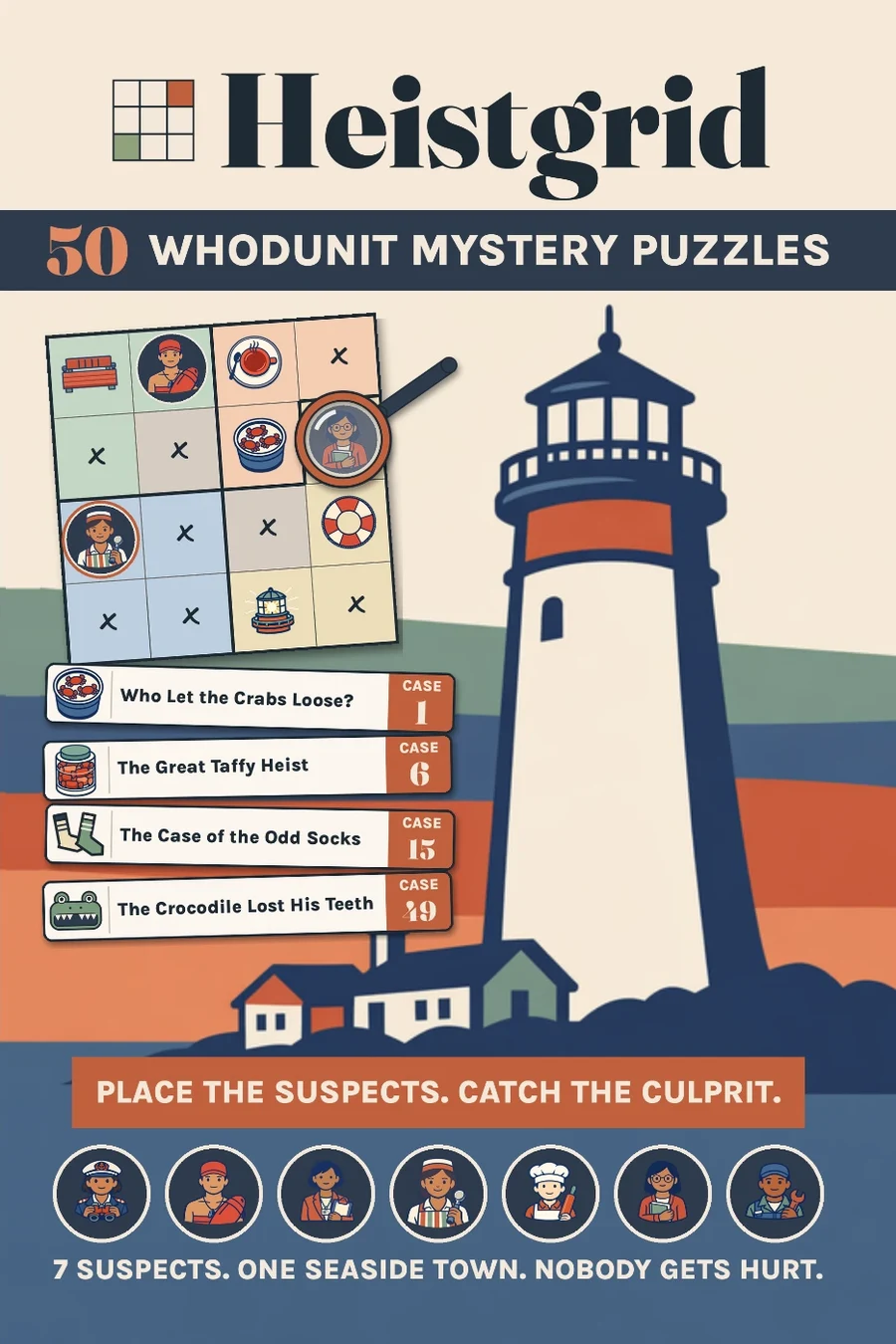
The book: 50 cases, from Junior Sleuth to Master Detective.
Buy the bookMore guides
- Pencil marks: the trick that makes hard logic puzzles easy
- How to solve a whodunit logic grid puzzle, step by step
- Gift ideas for puzzle lovers who like a mystery (Murdle, Murdoku and more)
- Logic puzzles for family game night
- Are murder mystery puzzle books OK for kids?
- A whodunit puzzle for two: solving together