Logic puzzles for family game night
Updated 6 November 2026
By the Heistgrid team, a small puzzle studio · How we check every case
Logic puzzles work well at family game night when one adult reads the clues out loud and everyone else places the suspects — start with a Junior Sleuth case, a small 3×3 board with direct clues that children of about eight and up can follow. For kids and teens who want a whole book of them, the cases run from that size up through four ranks, and the free ones play in your browser before you decide.
Are logic puzzles good for a family game night?
Yes — provided one adult is willing to lead. A logic puzzle is quiet in a way most board games aren't: no dice, no turns to wait for, nobody gets knocked out. One person reads the clues and keeps the group honest, and everyone else works on the same board together.
If your family has tried Murdle or Murdoku, the format will feel familiar; if not, nothing needs explaining beyond the rules page. Heistgrid cases are the gentle kind, so they suit a table with kids.
Our cases are written for adults, and they're gentle enough for the whole family. The crime in a Pelican Bay case is a knocked-over bucket or a missing pie. Nobody gets hurt, nobody is in danger, and every suspect is fine by the last clue. If game night at your house tends to get loud, this is a calmer table.
Which logic puzzle should a family start with?
A Junior Sleuth case. It's the smallest board we make — three suspects on a 3×3 grid — and the clues are direct: someone stood at the front, someone stood in a corner. Nothing hides, and nothing needs explaining twice.
Children of about eight and up can follow one from the start. Younger solvers can still take a real job: checking that no two suspects share a row or a column. It's the rule the whole puzzle rests on, and a child who holds it keeps the table honest. The free cases in this rank are listed on the case page, easiest first.
How do we split the jobs around the table?
One person reads the clues out loud. Everyone else places the suspects — writing names into squares, or moving tokens if you're playing on paper. Then swap for the next case. The reader hears the whole story and the placer holds the pencil, and after one board everyone wants the other job.
One job we'd assign on purpose: let the youngest read the final clue. The last clue names the culprit once the board is full, so whoever reads it gets the moment where the whole table turns to look at one person. That's the best part of the evening, and it should belong to whoever has the least practice.
What do we do when we disagree about who did it?
Go back to the clue. That's the habit worth teaching, and it's the reason these puzzles work as a family game rather than a shouting match: there is always exactly one answer, so a disagreement is never a matter of opinion.
If two people fit the final clue, the board isn't finished correctly yet — an earlier placement is wrong, and one of the clues will say which. Nobody has to win the argument. The clue settles it, and the clue doesn't take sides.
What can a teenager play who finds the easy ones babyish?
Move them up a rank. Inspector cases add who stood next to what, which is the first clue that needs more than one look. Head Detective cases add a witness who is lying: one of the statements is false, and you have to work out which before the board means anything. Those hold a teenager without an adult needing to hover.
The ranks are laid out on the case page, and our difficulty guide explains what each one adds, so a teenager can pick their own rung instead of being handed one.
What do we need on the table?
A pencil, an eraser, and something firm underneath. That's all. If you'd like the rules with pictures before anyone starts, they're on the how-to-play page, and the whole thing fits on one page.
Is there a book of these for kids and teens?
The cases are collected in a book — fifty of them, from those small boards up — the paperback is on the book page, and the free cases in your browser are a good way to try one first: a scene, a page of clues, a culprit to name.
Pick a small one, put the phone face down, and let the youngest read the last clue. Bring a pencil.
Try it yourself




Want 50 of these on paper?
Our book has 50 cases, from gentle to tricky, with step-by-step solutions at the back. About the book
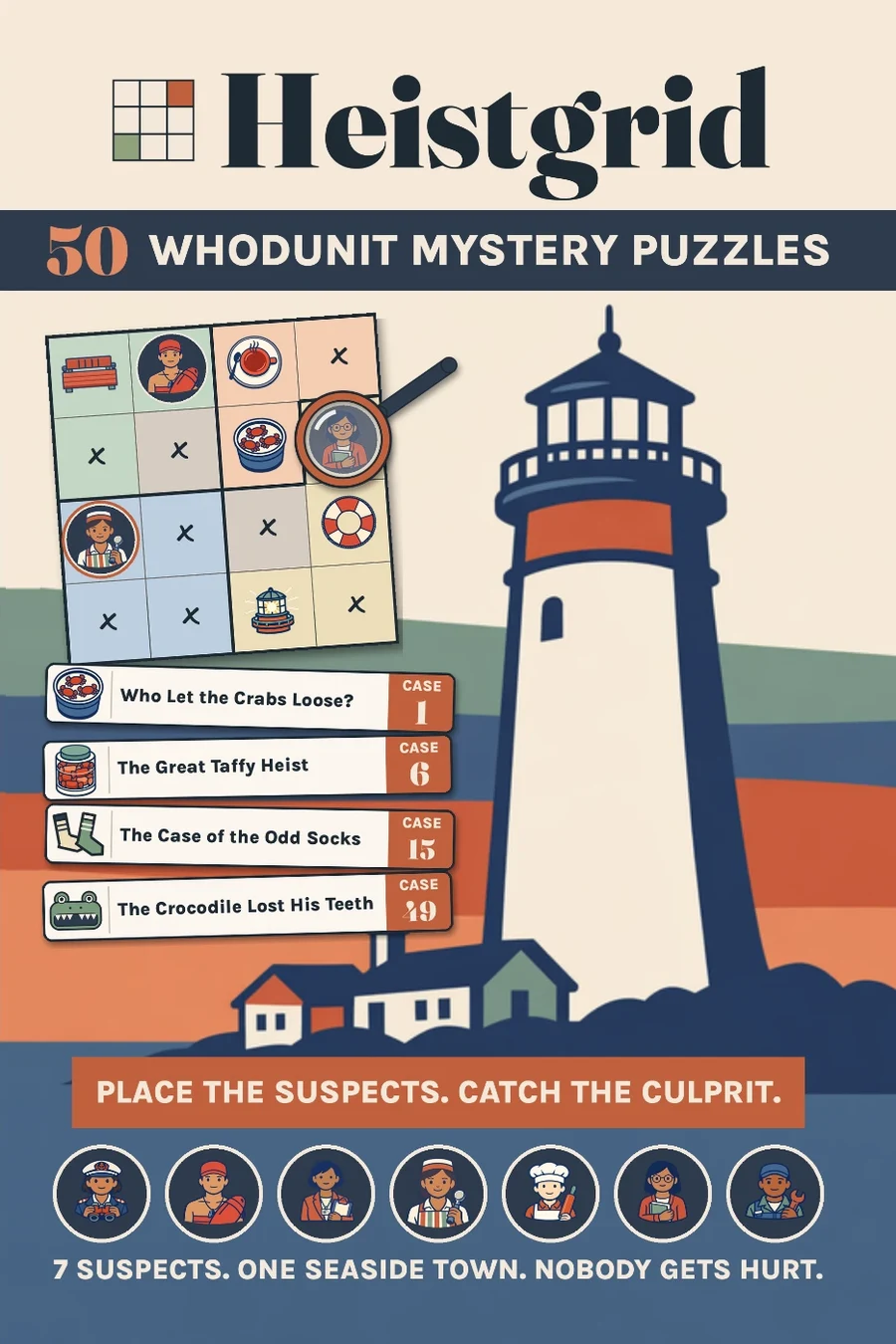
The book: 50 cases, from Junior Sleuth to Master Detective.
Buy the bookMore guides
- Cozy mystery puzzles where nobody gets hurt
- Which Heistgrid case should I start with? The four ranks explained
- Gift ideas for puzzle lovers who like a mystery (Murdle, Murdoku and more)
- Screen-free puzzles for adults: why paper still wins
- Are murder mystery puzzle books OK for kids?
- A whodunit puzzle for two: solving together