How to solve logic puzzles with rooms and zones
Updated 2 November 2026
By the Heistgrid team, a small puzzle studio · How we check every case
The harder logic puzzles — and the books like Murdle but harder — are the ones that add rooms and zones: the scene is split into areas, and clues say things like "in the kitchen" or "alone in the hall" on top of the usual row and column rules. Our Master Detective cases work exactly that way, and the method is short: fill the smallest room first, count what each room can hold, and let a room clue and a row rule meet on one square.
What makes a logic puzzle harder?
A logic puzzle usually gets harder in one of two ways: the clues start contradicting each other, or there are simply more things to hold in your head at once. Our Master Detective cases do the second kind. The scene is split into rooms and zones — a 4×4 board divided into four areas, or a 5×5 board with a hall, a kitchen and a back room — and the clues talk about those areas as well as about rows and columns.
Rooms and zones are the step up for anyone who has finished the easier Murdoku-style books: the scene is split into areas, and the clues talk about areas as well as squares.
Nothing about the puzzle changes underneath: it still has exactly one answer. The room layer just gives you a second way to look at the same board.
What does "in the kitchen" mean in a clue?
A room clue is a range, not a spot. "Ada was in the kitchen" means somewhere inside that room — any of its squares, not one particular one. "Ben was alone in the hall" is much stricter: nobody else stood in that room at all, so every other square in the hall is out for everyone else. And "Cleo was beside Dev" means the two of them were in the same room; it doesn't promise their squares touch.
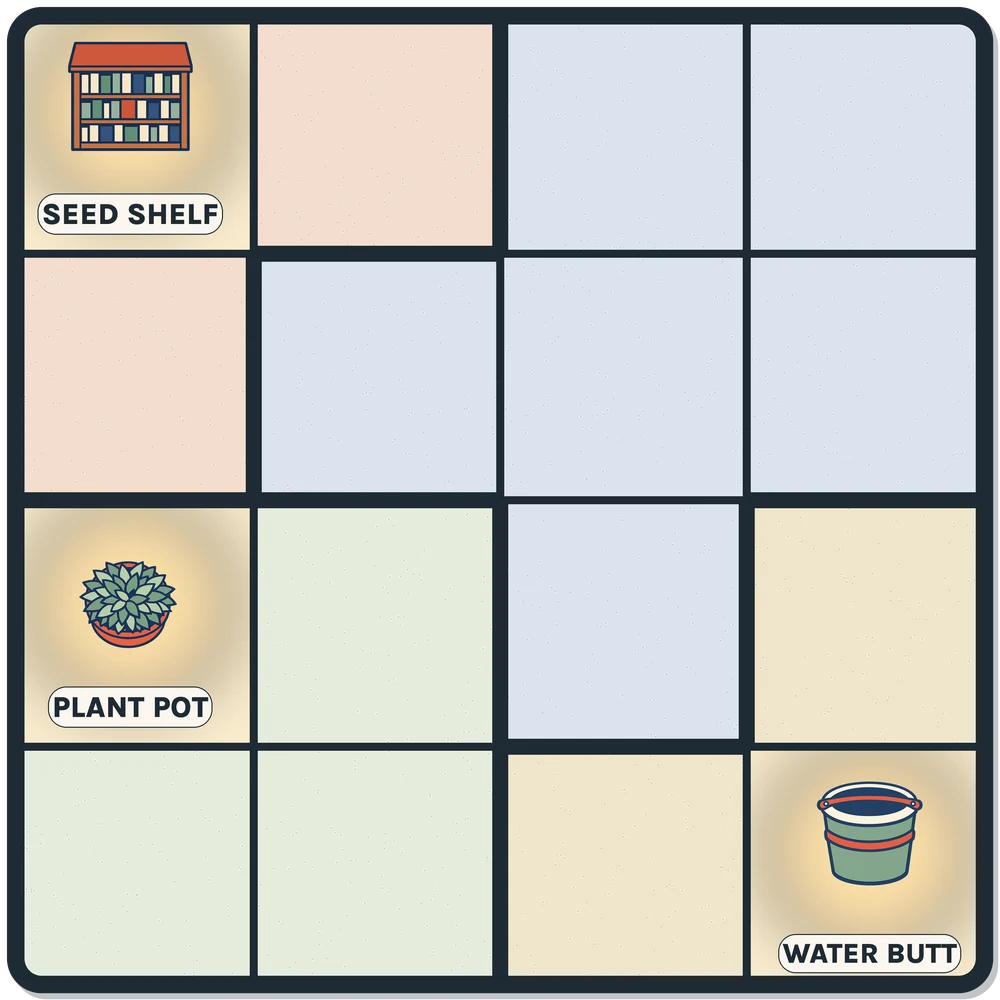
Reading those three phrasings correctly is most of the work. Once you know a clue narrows a room rather than naming a square, you stop hunting for a placement the clue never gave you.
Do the normal rules still apply?
Yes, unchanged: one suspect per row and per column, and grey squares are taken by objects. Rooms sit on top of those rules instead of replacing them. That's the useful part — a room clue and a row rule can point at the same square from two directions, and where they meet is usually your next placement.
Where should I start on a room puzzle?
Fill the smallest room first. A room with two squares can hold at most two suspects, so if three people are in play and two of them are already placed elsewhere, the third can't go there — and that's a placement, not a guess.
Before you place anything, count what each room can hold: how many squares it has, how many of those are grey, and which rows and columns running through it already have someone in them. A big open room looks inviting and often gives you nothing; the tight one gives you an answer.
How do I combine a room clue with the row and column rule?
Made-up example: the study is the four squares in the top-left of a 4×4 board, and the clue says Ada was in the study. Two of those four squares sit in a row that already holds Ben, and one sits in a column that already holds Cleo. That leaves Ada exactly one square in the study — found by two rules meeting, not by luck.
This is the move that turns a room puzzle from a slog into a chain. Each room you resolve narrows a row or a column, and each narrowed row or column narrows the next room.
Should I use pencil marks for rooms?
Yes, and keep them per room rather than per square. Write the names that could still stand in a room along its edge, and cross names off the room as rows and columns fill up. When a room is down to one name, that's your next placement — and the square it goes on is the one its row and column leave free.
On paper, a light pencil and a soft eraser help. On screen, you can jot candidate names in an empty square and clear them the moment someone is placed.
What should I play next?
If you want to try the format, the Master Detective cases are listed together on the case page — start with a 4×4 one and give yourself a pencil and a few quiet minutes. The rules for reading a board are on the how-to-play page, and every case has exactly one solution, so if you're stuck the answer is somewhere in the clues rather than in a guess.
Try it yourself




Want 50 of these on paper?
Our book has 50 cases, from gentle to tricky, with step-by-step solutions at the back. About the book
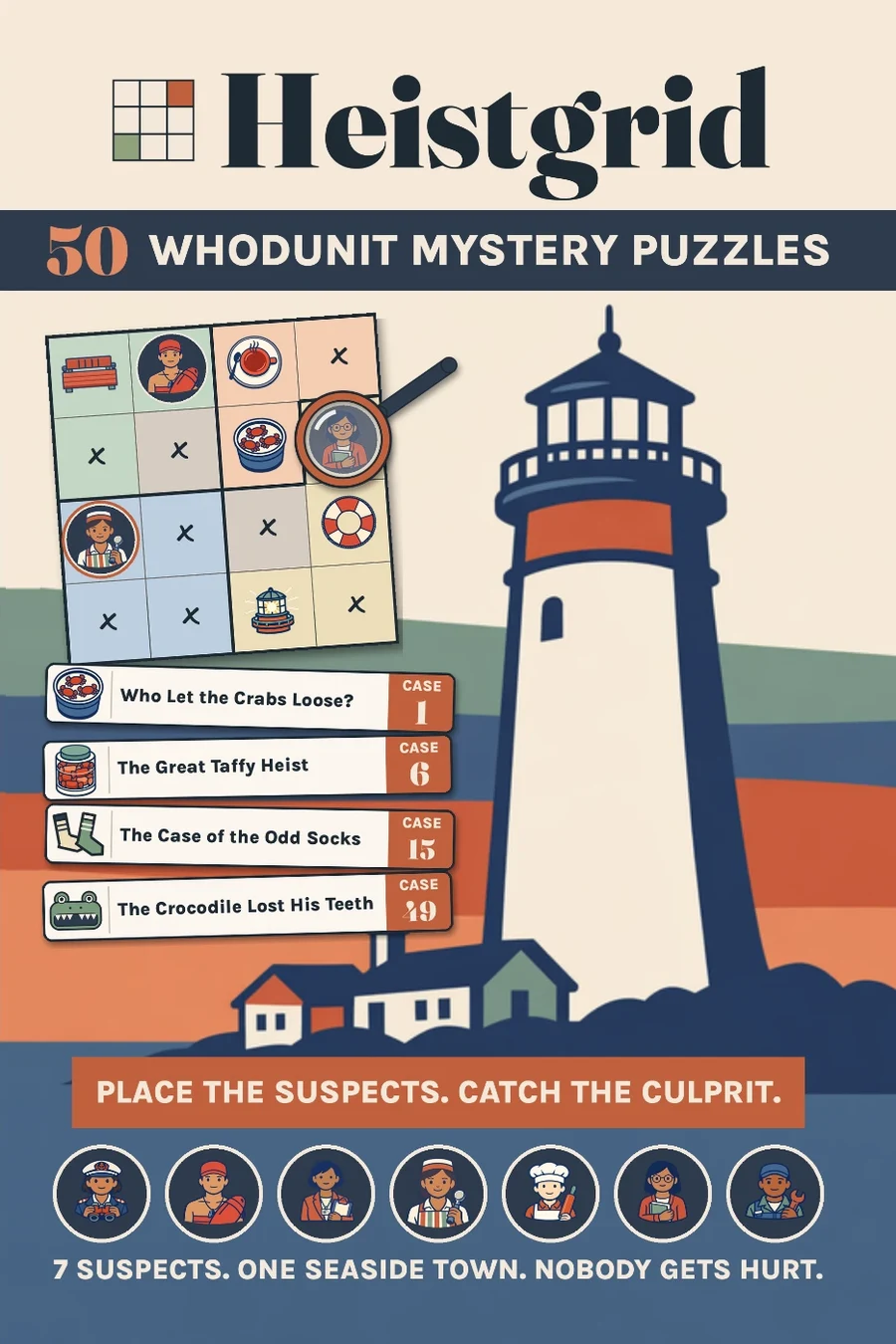
The book: 50 cases, from Junior Sleuth to Master Detective.
Buy the book