Easy logic puzzles for adults: a gentle way in
Updated 11 November 2026
By the Heistgrid team, a small puzzle studio · How we check every case
A good easy logic puzzle for adults isn't childish: it has exactly one answer, a small grid and direct clues, and it lets you check your answer afterwards so you can see where your reasoning held up. Our Junior Sleuth cases work exactly like that, on a 3×3 board with clues that tell you a row or column outright, and each case tells you straight away whether you've found the culprit.
Are easy logic puzzles only for kids?
Not at all. "Easy" describes how many steps a puzzle asks you to hold in your head at once, not who it's for. An easy puzzle still asks for real reasoning: you read a clue, rule something out and watch the answer appear. That small click of "oh, it has to be there" is the whole pleasure, and it feels just as good at forty as it does at ten.
Plenty of adults want exactly that. Something calm after work, something to share at the kitchen table, or a way back into puzzles after years away. Starting gentle isn't a step down. It's how you learn the habits that make the harder ones fun instead of frustrating.
What makes a good first logic puzzle?
Three things matter more than anything else.
Exactly one answer. A fair puzzle has a single solution you can reach by logic alone. If two answers fit, you end up guessing, and guessing is the opposite of the fun. We check every one of our cases for this before it goes out.
Answers you can check afterwards. Knowing whether you got it right is how you learn. If you were wrong, you can go back and find the step where your thinking slipped, which teaches you more than any rule list.
A small grid. Fewer people and fewer places means each clue rules out a lot. You see the effect of every deduction straight away, and the puzzle never feels like a wall of possibilities.
What does an easy logic puzzle look like?
Here is our demo case. Three people were in a 3×3 library: Otto the baker, Mabel the museum guide and Priya the librarian. A returns cart takes one spot. Each row and each column holds exactly one person.
· front ·
The clues are direct. "Priya was at the front of the library" puts her in the top row. "Otto was all the way on the left" puts him in the left column. "Priya was standing to the left of Mabel" settles the rest. Then a final clue points at the person standing right next to the cart.
Try it in your head before you look below. When you're done, check your board against the answer.
· front ·
 Priya
 Otto
 Mabel
If you'd like every step spelled out, our guide to solving logic grid puzzles walks through this case one clue at a time.
Where can I find logic puzzles for adults with answers?
Our Pelican Bay cases are built for this. Each one is a small whodunit: you place the suspects on a map of the scene, then pick the culprit. When you choose, the case tells you straight away whether you've got it right. If you get stuck after a few wrong tries, it offers a hint, so you're never left staring at a board with no way forward.
Nobody gets hurt in Pelican Bay, either. The cases are about missing things and small heists, which makes them easy to share with anyone at the table.
Which of our cases should I start with?
Start with our Junior Sleuth rank. These cases use a 3×3 board and direct clues, just like the demo above: "at the front", "on the left", "in the middle row". You won't need to juggle two people at once or wonder whether a witness is lying.
Once Junior Sleuth cases feel comfortable, the next ranks add one new idea at a time: a bigger board, clues like "next to", a witness who isn't telling the truth. Our guide to the four ranks explains when it's a good moment to move up.
Any tips for a gentle start?
Read every clue once before placing anyone. Place the people a clue pins down exactly, then let "one per row and column" fill in the rest. Keep a pencil handy if you're on paper, and don't be shy about starting over. Every solver does.
Most of all, go slowly. An easy puzzle solved calmly teaches you more than a hard one rushed, and the calm is half the point.
Try it yourself




Want 50 of these on paper?
Our book has 50 cases, from gentle to tricky, with step-by-step solutions at the back. About the book
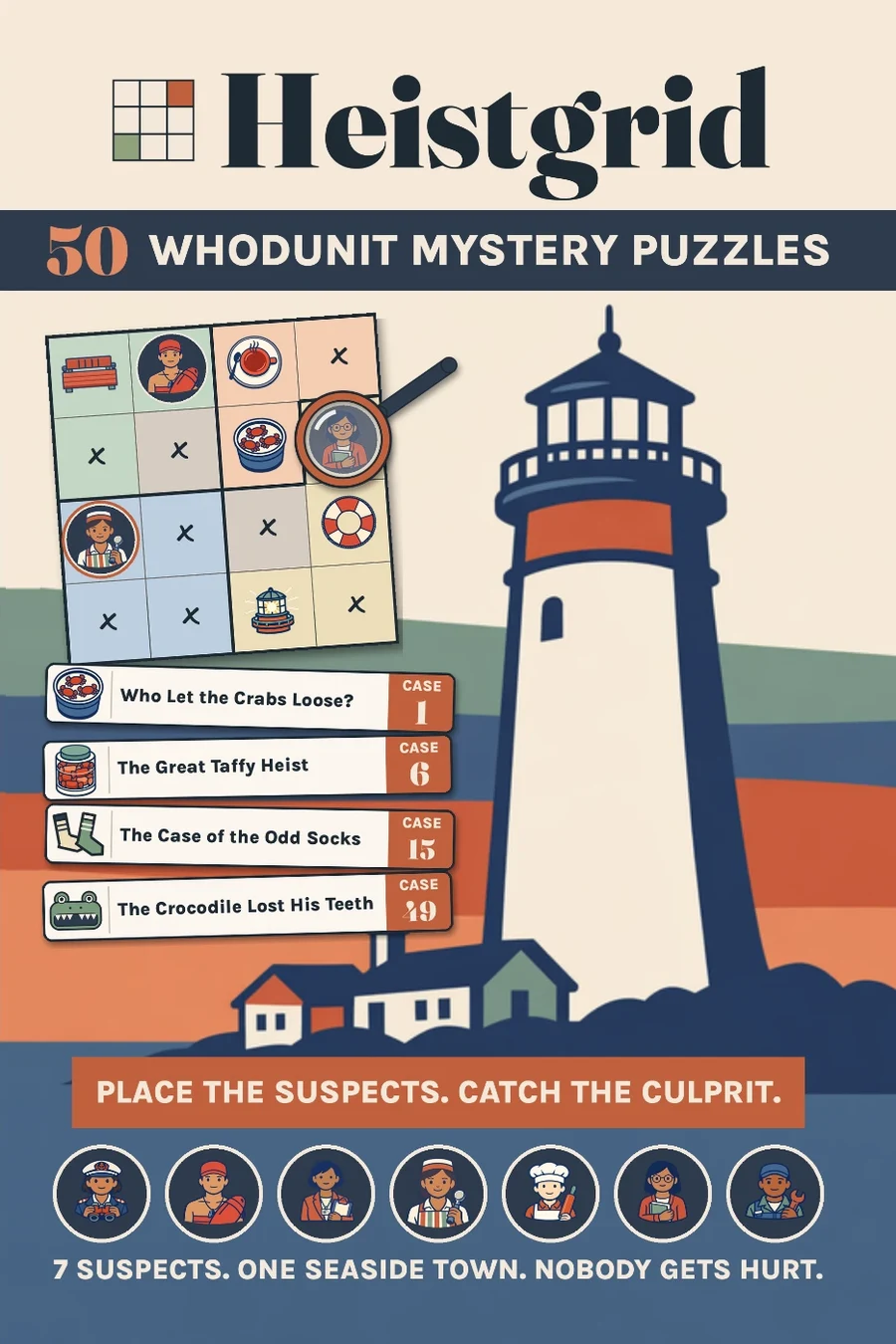
The book: 50 cases, from Junior Sleuth to Master Detective.
Buy the book